We are proud to be Americans in our office. We understand the sacrifices our soldiers make every day to ensure we are the greatest country in the world.
On this day 245 years ago, the Second Continental Congress changed the appearance of the United States flag because the original was too similar to the British flag. George Washington decided that wasn’t a good confidence-builder for the revolutionary effort, so he wanted a new symbol of freedom.
The new “flag of the United States be 13 stripes, alternate red and white and that the union be 13 stars, white in a blue field, representing a new constellation.”
Over 100 years later, in 1916, President Woodrow Wilson officially established June 14 as Flag Day!
So, what do we do to show our American pride at PGT? Line flags all up our walkway to our main entrance for everyone to see.
Did you know May is the least active month of the year? That only seems fitting as it leads right into hurricane season which runs from June through November, with September being the most active month.
What’s in store for 2022? Well, it doesn’t look promising.
While there are no active tropical storms at the time this blog is being written, that doesn’t seem to be the prediction for the rest of the season.
According to NPR, scientists are predicting at least 19 named storms and nine hurricanes this season. Of the nine hurricanes, four are expected to be category 3 or higher.
Sounds like an intense season is upon us. Those numbers are all above average.
What does that mean for us?
The logistics industry will feel the impacts. Shippers and receivers in coastal areas will have the obvious impacts, but that doesn’t mean others won’t. Drivers will avoid going to certain areas, which will limit capacity. After a storm makes landfall, freight will increase to the impacted areas for recovery efforts, which will drive up rates to those areas. Often, in any natural disaster, fuel availability becomes a very hot topic.
The easy answer is to hope and pray their predictions are wrong. The more realistic answer is to prepare and stay current on the storms throughout the season.
One thing we can guarantee? Our team at PGT will stay on top of all storms and situations. We will provide you with any updates and help guide you through any challenges that arise because of it.
Give us a call at 513-575-7645 and we will prove it to you!
No time like the present to prepare. In fact, time is running out to prepare for the national truck safety blitz. How will it impact you? When will you start to feel the impact? How long will it last? Why does it impact you at all? We will answer those questions and more.
The Commercial Vehicle Safety Administration (CVSA) conducts safety blitzes across North America around this time every year. They work closely with the Federal Motor Carrier Safety Administration (FMCSA)- an organization we are all too familiar with.
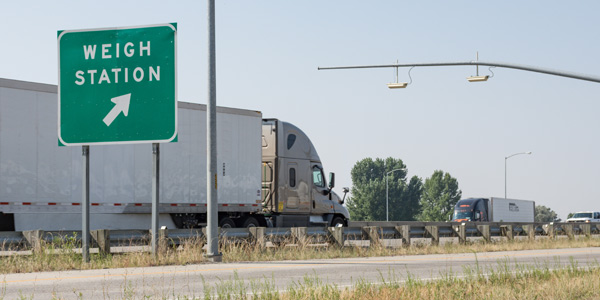
What’s the point? At their core, roadchecks are conducted to promote safety of all drivers, pedestrians and shipments on the highways. The CVSA partners with local highway patrol and inspectors at various inspection/weigh stations as well as temporary inspection checkpoints.
What are they checking for? There’s a primary focus every year, but it ranges from mechanical issues commonly found on commercial vehicles to driver credentials, health, and HOS compliance. This year, the focus is on wheel-end components. By narrowing the focus to one or two items, they are able to operate at maximum efficiency. To put that into perspective: the CVSA and their partners have been able to inspect about 15 trucks EVERY MINUTE.
When is it? This year, it will begin Tuesday, May 17 and run through the evening of Thursday, May 19.
What will we start feeling the impact? Traditionally, the greatest impact is felt that entire week, but it often starts as early as the week before. For planning purposes, prepare yourself for impact to start as early as May 11 and continue through May 22.
“Truck capacity will tighten. Rates will escalate for a short period of time but will certainly bounce back. It would be a good idea to get ahead of freight the week before and game plan with your logistics providers.” – Taylor Allen, Logistics Coordinator
Why does it impact you? Truck drivers hate blitz week. It isn’t uncommon for carriers to sit out that week. Regardless, capacity becomes extremely tight and rates tend to skyrocket. If drivers are going to run during a safety blitz, they are going to demand more money to do so. If not, it’s not worth their hassle most of the time.
As with anything, there are several stereotypes toward brokers. The reality is, most aren’t true. The problem is, most people simply do not understand everything a broker does on a daily basis. It doesn’t start and end with covering a load. There is much more to it than that.
In today’s Table Talk, you’ll hear the truth about brokers.
In today’s world, jobseekers have their choice of jobs. It’s no secret there are MILLIONS- over 11 million to be more precise- of job open, so the options are endless. Yes, you read that correctly- millions of openings across the United States alone.
The logistics industry is no different. There are thousands of jobs to choose from and your choice of companies as well. In fact, there are five million more job openings than unemployed people in the U.S. according to the U.S. Bureau of Labor Statistics.
So how do you decide?
We can’t answer that entirely because it’s different for everyone. All we can do is tell you why you should come join the PGT team.
WE HAVE TWENTY SALES OPENINGS & SEVERAL OTHER ROLES WITH OPENINGS ALSO!
So why should you pick PGT over the millions of other options? The top 4 reasons are below, but really, we could talk about it for days.
The pay. People often save the best for last, but let’s be real- this is what most people care about first. We pay above the industry average. We are always hiring sales brokers. Why? Because we are always growing to better serve our customers. Our brokers make base + 40% uncapped commission! No, that’s not a typo. FORTY PERCENT UNCAPPED COMMISSION! Why? Because we want you to join our team and stick around for the long-term. What better way to do that to pay you what you deserve?
What about everyone else? Our logistics coordinators make a very competitive base salary plus uncapped commission on their broker’s book of business. Our back-office associates make at the high end of the industry standard! We believe in our people and are willing to pay what they are worth!
The atmosphere. Relaxed. Casual. Fun. Sound good yet? PGT is all those things and then some. We want everyone to enjoy coming to work. Sure, there are always going to be bad days, but we believe there are more good days than bad here. There are TVs going, music in the background, and often jokes and stories flying back and forth. We enjoy simple things like casual attire, walks around the building, flexibility, and team events outside of the office.
The benefits. Our list of benefits continues to grow as we grow. We currently offer a 401k with a 401k match! We want you to be with us until you retire, so let us help get you there. We pay a cell phone stipend and paid time off at time of hire. In addition, we can get you set up with medical, dental and vision insurance. Not bad for a company less than two years old, right?
Growth potential. New company = endless opportunities. We have a solid staff that has laid the groundwork for success, now we just need you to help build the foundation of our future. As we grow, so do the opportunities. The potential to move up into various other roles is endless. You can do as much as you want with us and go as far as you want to go. You control your destiny when you work at PGT. How far do you want to go?
Come join our team! Apply on Indeed or just give us a call at 513-453-6046 to set up an interview.
In today’s Table Talk with PGT episode, Kandra, Taylor & Jake explain why shippers/manufacturers should partner with PGT. They touch on several important pieces to the industry. Check it out in the video below.
The trucking industry powers our country. Without it, shelves would be empty and we wouldn’t have access to nearly anything we need or use on a regular basis.
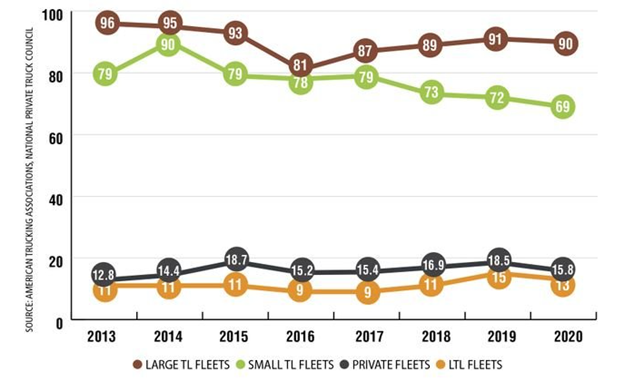
It is clear truck drivers are important. Aside from the driver shortage already plaguing the industry, another major concern is the high turnover rate. At around a 90% turnover rate for large fleets, it is one of the highest rates in the country.
Generally speaking, people often associate turnover with leaving the industry. When it comes to truck driving, however, that’s not the case. In a majority of cases, turnover in the trucking industry means switching companies. The kicker to all of that- in 2021, carriers lost about one new driver for every twenty they hired IN THE FIRST SEVEN DAYS.
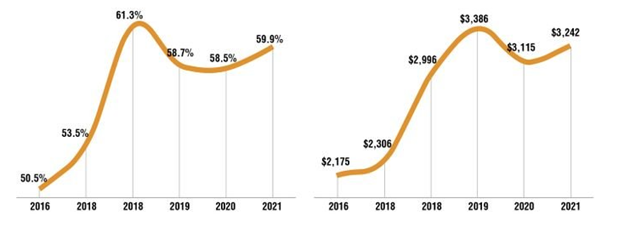
Turnover happens in every industry for various reasons. Truck drivers are in such demand that companies are incentivizing drivers to come work for them with huge sign-on bonuses and more competitive pay. In 2016, about fifty percent of companies were offering sign on bonuses that averaged around $2,000. It peaked in 2018 at 61% with a bonus of about $3400. Last year, wasn’t too far off from that peak- 60% of companies offered sign on bonuses that averaged almost $3300. Companies like Wal-Mart offered $8000 sign-on bonuses in 2021.
What does high turnover in the trucking industry mean for
all of us?
It’s pretty simple- higher prices. Companies are losing a lot of money to turnover. The recruiting, hiring, training, and bonuses associated with hiring new truck drivers doesn’t come cheap. It costs thousands of dollars that essentially get thrown out the door when the driver quits for a new sign-on bonus. Companies don’t take on this cost without passing it through the supply chain, ultimately ending up to the consumer with higher priced goods. I think we are all feeling the higher prices at this point.
The market that tends to see the most fluctuation is definitely the reefer market. The ups and downs are so drastic that the swings often occur weekly.
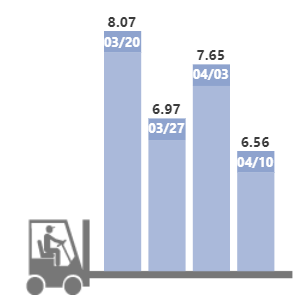
That holds true in recent weeks. Just take a look at the graphic from DAT to the right. The number of loads available in the spot market compared trucks continues to flow like a rollercoaster. In theory, as we continue to get into peak produce season, these numbers should flatline on the higher end.
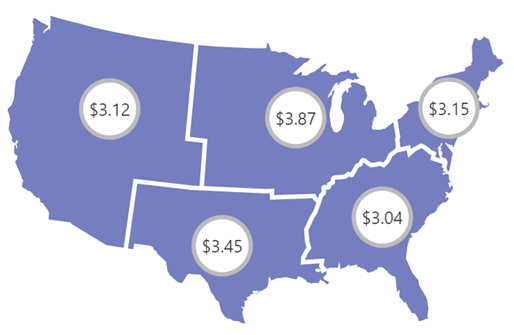
The closer we’ve gotten to produce season this year, the quicker reefer rates continue to drop. Reefer rates are always higher than van rates due to the extra cost and risk involved with temperature-controlled freight, but the gap isn’t as big as it has been in recent history. In fact, in some parts of the country, rates are only thirty cents per mile higher.
Reefer Spot Rates by zone across the US according to DAT.
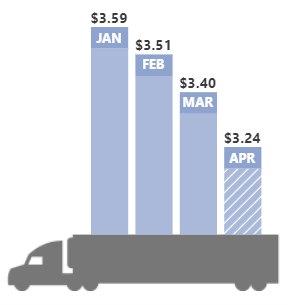
Rates are still slightly higher than they were a year ago, but not by much. The reefer rates in April are averaging over thirty cents less than they were only three months ago. Will this trend continue? Probably not in the short-term because load volume will pick up over the next couple of months and mess with the supply and demand ratio.
The good news is, for the first time in a long time, trends are starting to turn in our favor. Whether or not that will continue and be sustainable is yet to be determined.
Do you need temp-controlled freight moved? Are you tired of unreliable service? Do you value honesty and proactive communication? If you answered “YES” to any of those questions, you need to give us a call. We can help with all of those things…AND…save you money in the process.
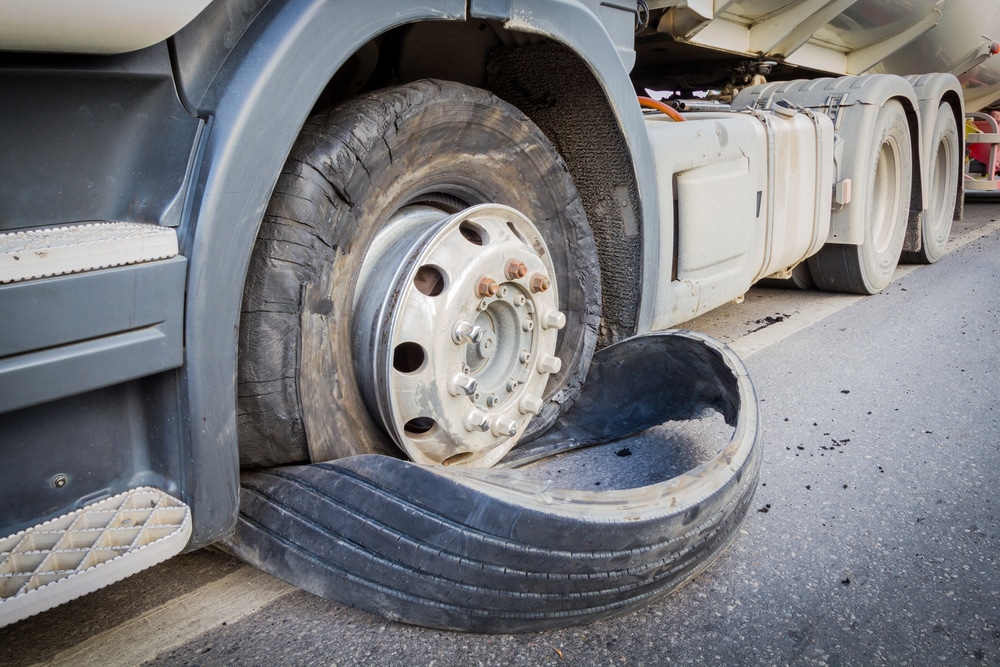
As temperatures continue to rise, so does the dreaded tire blowout.
It is a real problem, especially in the summer. There are ways to prevent it from happening, but nothing is 100% fool proof.
There’s a long list of reasons a driver could experience a tire blowout. We don’t have time to address them all, but let’s start with a top-5 list and then break down (no pun intended) a few of them to get a better understanding of what happens:
1. Heat/Weather 2. Driver Negligence 3. Defective Tires 4. Overweight 5. Potholes/Object on the road
Obviously heat and weather are out of anyone’s control, but it can be one of the leading causes of tire blowouts. It is exponentially worse between mid-May and early October due to the rising temperatures across the country. Driving for long periods of time in high temperatures puts a lot of strain on tires. Add in even hotter temperatures on the road itself, and it’s no surprise the damage it can cause.
Driver Negligence and defective tires could go hand in hand at times. Drivers are required to do pre and post trip inspections, primarily for safety. One of the parts they should inspect are the tires. They need to confirm they are inflated properly and make sure they are not overworn- both of which could lead to tread separation if not properly addressed. Drivers also need to look for any defects that are visible. Not all defects are visible, some are inside the tire. These types of defects are likely to cause tires to blow when they go over potholes, broken glass, or bumps in the road.
There are strict weight guidelines for multiple reasons, but one is definitely tire capability. Overloading cargo can put too much pressure on tires and cause them to explode. It is important for drivers to go scale if there is any question that the load could be overweight.
Obviously, no one wants to be in that situation. Tire blowouts can cause serious accidents and a lot of damage. It is vital that all precautions are taken and that everyone remain calm and in control in the event that it does happen. And a friendly reminder: if you see a truck (or anyone for that matter) on the side of the road, please pull over and/or slow down. It’s a stressful situation by itself, let’s all do our part to not make it any worse.
Today, Team Jake talks about industry changes over the years and how prices/costs have increased over the years. Better yet, they talk about how we handle them and how our customers should navigate the ever-changing dynamics of shipping freight. Enjoy today’s video below.